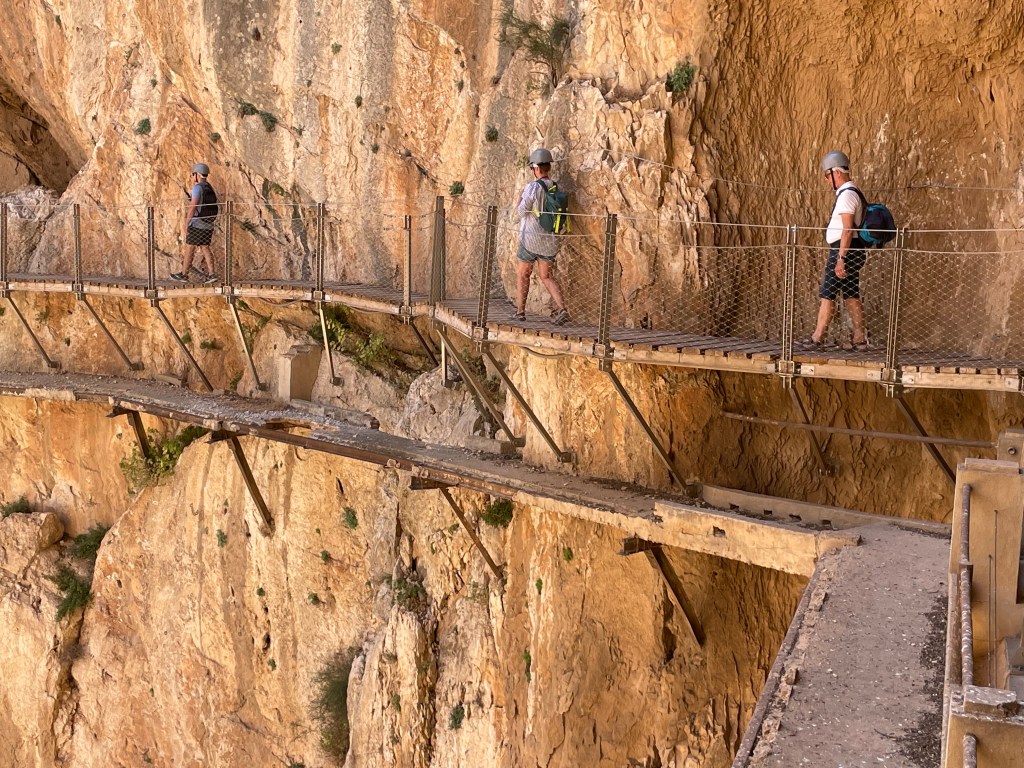
Our Friday fun-day adventure was to walk the 5km El Caminito del Rey (The King’s Little Path). It’s a walkway that clings precariously to the vertical sides of a narrow gorge in El Chorro, with the Guadalhorce River churning across the rocks some 100 metres below. If you’re afraid of heights, it’s the stuff of nightmares.
The walkway started life as a footway for construction workers and their pack animals working on the hydro-electric project. When the hydro project was finished, the walkway was named El Camino del Rey (The King’s Road) as King Alfonso XIII was to officiate its opening in 1921. But the Spanish, love them, abbreviated it to the King’s Little Path (‘El Caminito Del Rey’) after the King walked only about one-quarter of the way.
In all fairness to King Alfie, it must have been a dizzying, hair-raising walk in 1921, narrow, without handrails, and held up only by supports wedged into the cliff face below.
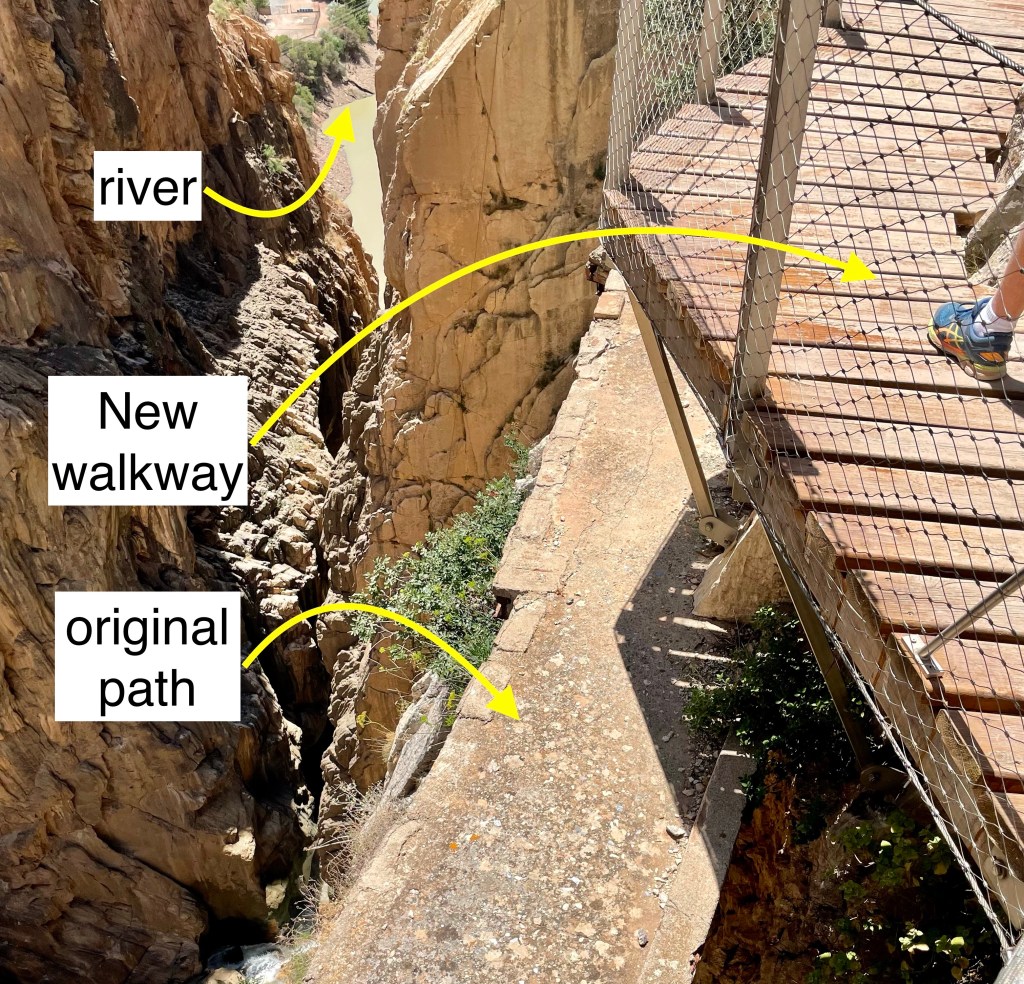
Thankfully, there’s a new walkway now, opened in 2015. But many parts of the original path remain. From the relative safety of the new walkway, you can gaze upon the treacherous, crumbling death trap below.

The number of people who died on the path is difficult to determine, although it seems five people died in just two years (1999 and 2000), the last being a 50-year-old woman. Newspaper articles claim “numerous people” have been killed on “the world’s most dangerous footpath” but the hard data is scant.
The Spanish appear to have a far greater tolerance for death, and next to no regard for safety (they tend to take an ‘at your own risk’ approach) compared to other Western countries. When accustomed to the ‘nanny state’ existence of Australia, where bike helmets are compulsory, where every level change has a safety rail, every hole is cordoned off, and every step is regulation height, a trip to Spain is both eye-opening and refreshing.
For example, in the plaza last weekend, Rosco and I, together with hundreds of other people, simply walked through the set-up for a concert, over and around cables, equipment, men, pieces of stage and a half-erected lighting rig. The same situation in Australia would see the whole area restricted by a two-metre-high fence, big warning signs, the obligatory CFMEU union flag, a stop/go person, and a phone number to ring for complaints! In Australia, the Caminito Del Rey walk would have been closed after one death!
But I digress.
We have been looking forward to this hike for weeks. We had booked our tickets on-line, a necessity on account of the walk’s enormous popularity and the strictly enforced number cap. Even Rosco, a man not known for his love of exercise, was enthusiastically marching around the apartment earlier in the morning proclaiming that he was going to be “a hike-ist“.
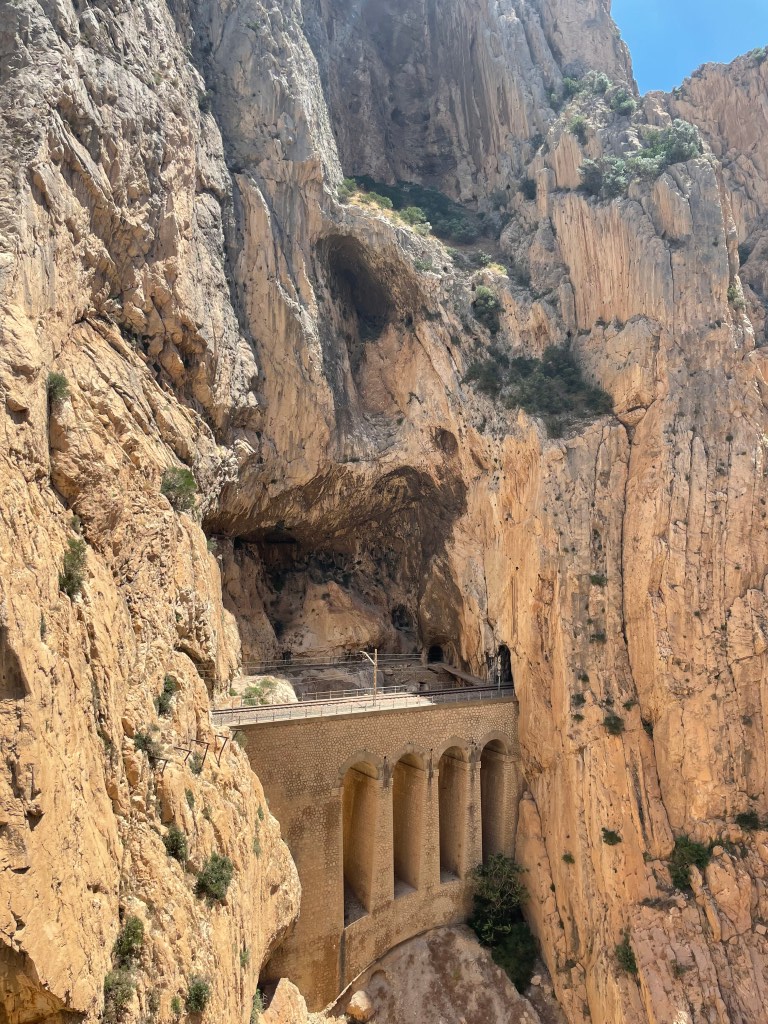
We caught the regional train towards Seville, which deposited us at the tiny El Chorro station 40 minutes later. El Chorro is a charming little village, rightfully proud of its 1865 historic railway station and hand-made tunnels, all 14 of them, through the formidable mountains. The engineering feat is astounding.
A shuttle bus collects us from the train station, taking us to the start of the trail. During the 25-minute bus trip, parts of the trail can be seen from the windows, clinging to the side of the sheer cliffs. I turn to Rosco after hearing the sharp intake of breath. “Is that the walk?” he asks incredulously? “I’m not good with heights” he states. To my amazement, it turns out he didn’t look at any of the pictures from the booking website, or even the numerous videos or photos from our friends Bob and Irene when they did the walk last year. *Eye roll. The bus drives on, with Rosco ashen faced next to me, his earlier enthusiasm considerably dampened. He mutters something about the inflatable boat trip I “made” him do in Portugal four years ago. Yup, he’s very, nearly over it.
The shuttle bus drops us off and we quickly eat at a little bar wedged between the road below and the rock behind. Some big-breasted English girls, dressed for the hike in bikini tops, are nearby, trying to take group selfies. Rosco nearly upends our breakfast in his enthusiasm to take a photo for them. He’s such a helpful chap.

From the shuttle bus drop-off, the instructions, translated from Spanish, are to ‘go through the tunnel and walk the short path to the start of the trail’. After walking for about 20 minutes, and with no-one else on the trail, Rosco loudly questioned my ability to translate directions and instructions. To be fair, I have appalling navigational skills, so I don’t really blame him.
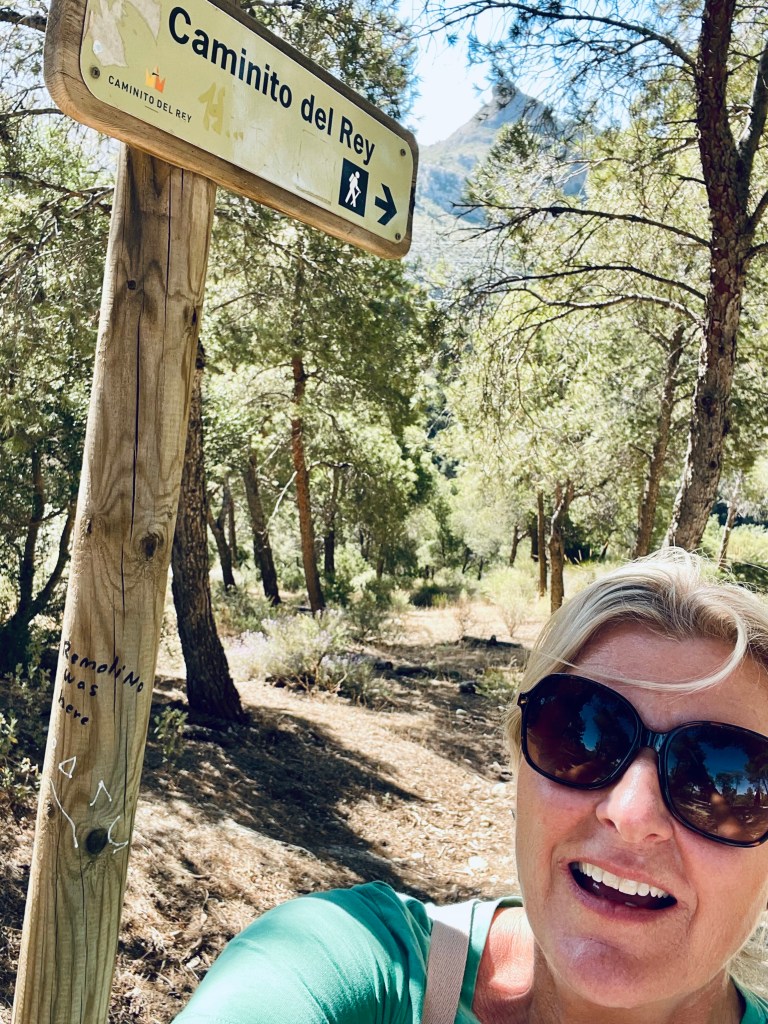
Just when Rosco’s complaints about my navigation reached their crescendo, we saw the hut ahead by the river’s edge. I don’t let on how relieved I am, thankful we don’t need to spend hours wandering lost in the forest at the mercy of Spanish drop bears.
At the starting hut, our names are checked off and we are split into groups, based on language, and we don hair nets, helmets and audio pieces.

Our guide, Sam *not his real name*, in heavily accented English, tells us interesting stories and history as we walk along. He calls us, his tour group ‘my family’ as in, “my family, come to me and I show you where to take the photo”.
In amongst all the rules (keep your helmet on, don’t leave the path, only four people on the platform at a time etc), Sam tells us we will cross two gorges (which he pronounced as jaw-jess). Rosco tells me I am jaw-jess (gorgeous) – an apology, no doubt, for questioning my navigation skills! It’s all very funny.
From the first few steps on the walkway, it’s breathtaking, dizzying, amazing and slightly terrifying. The sky is bright blue, starkly contrasting against the cliffs which tower above us, hard and straight, the result of shearing tectonic plates. Below us, the gurgling river, visible through the inch-wide gaps between each board, provides a constant rhythm of sound. These photos do not do the Caminito Del Rey justice.
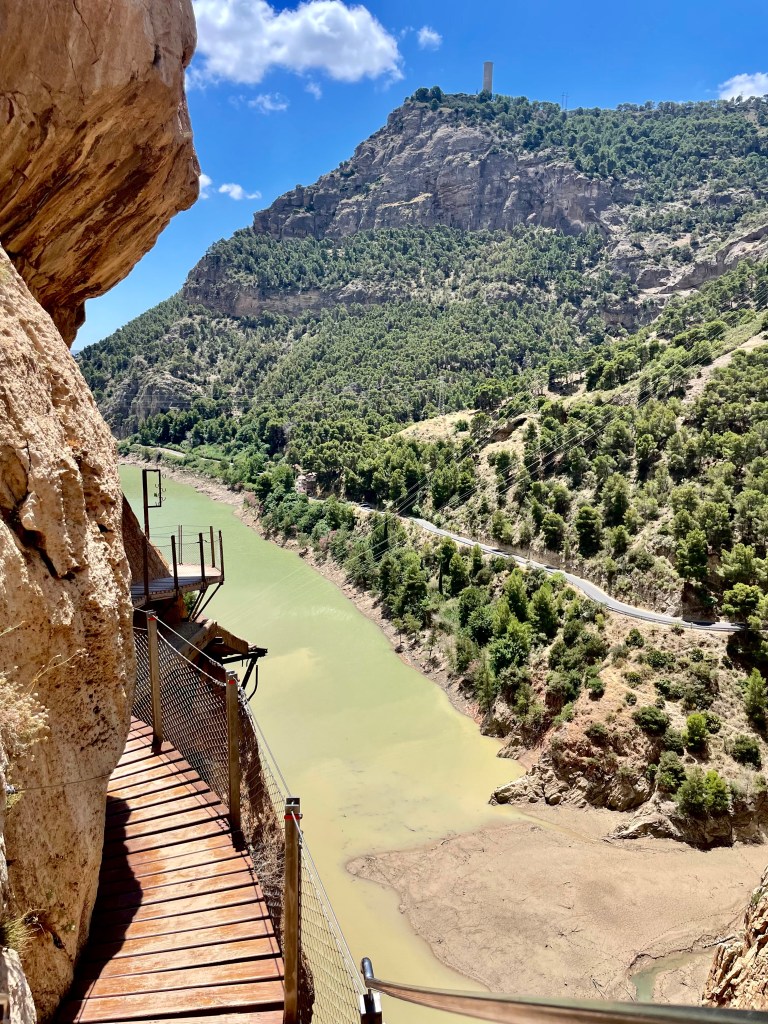
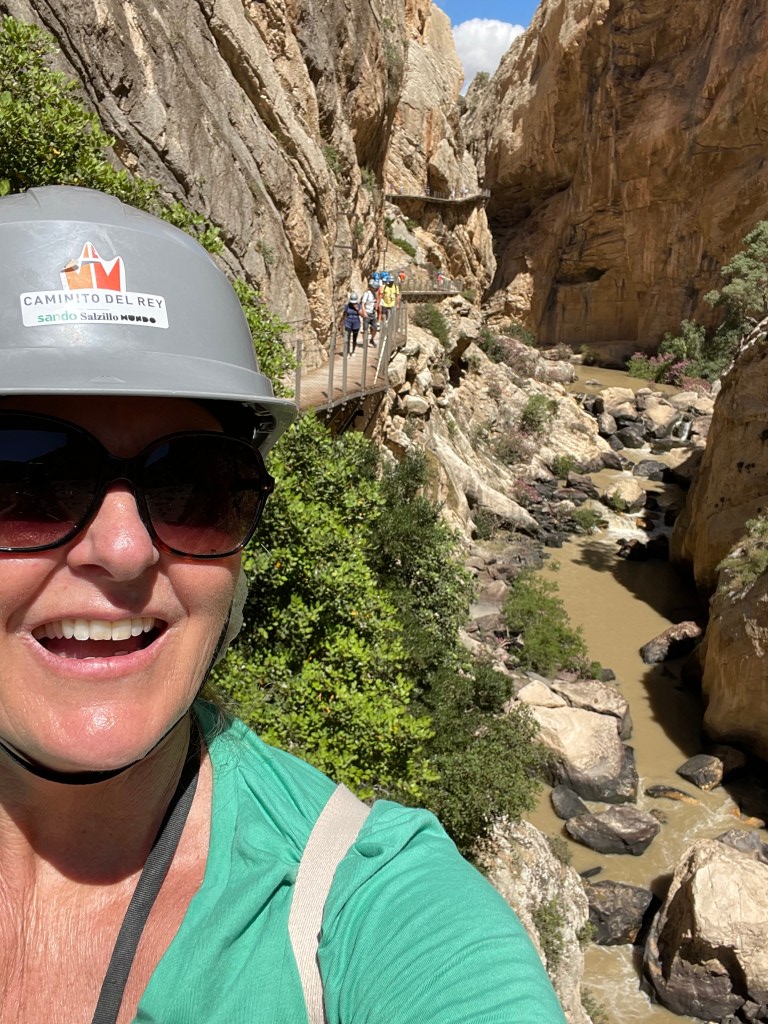
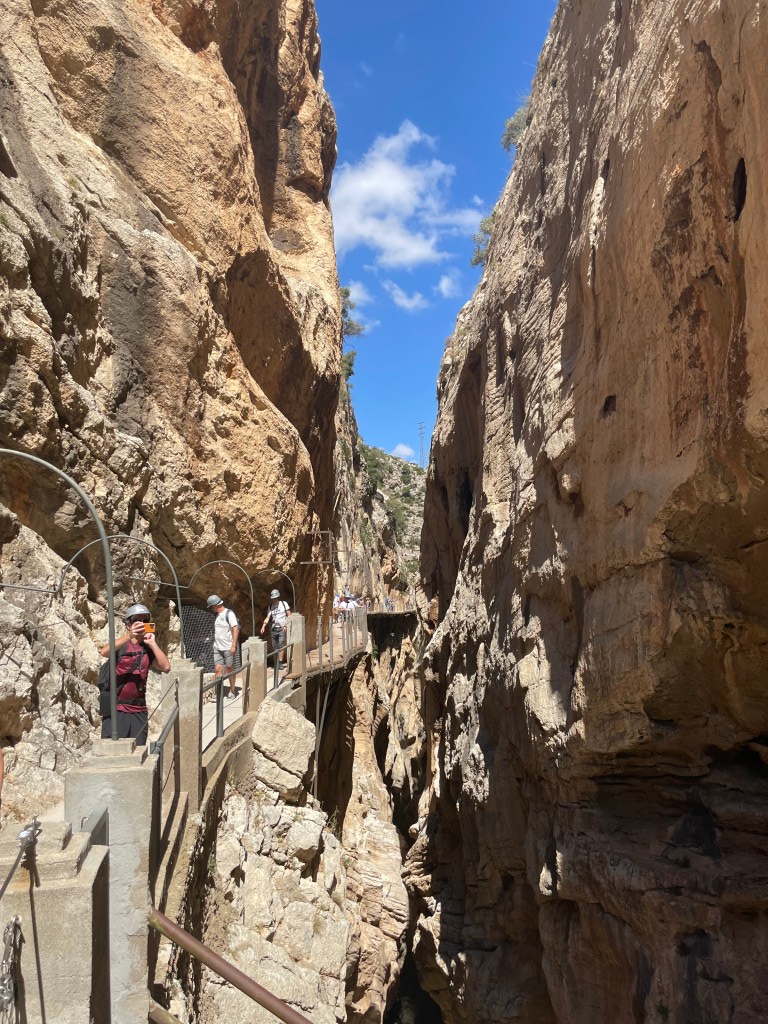
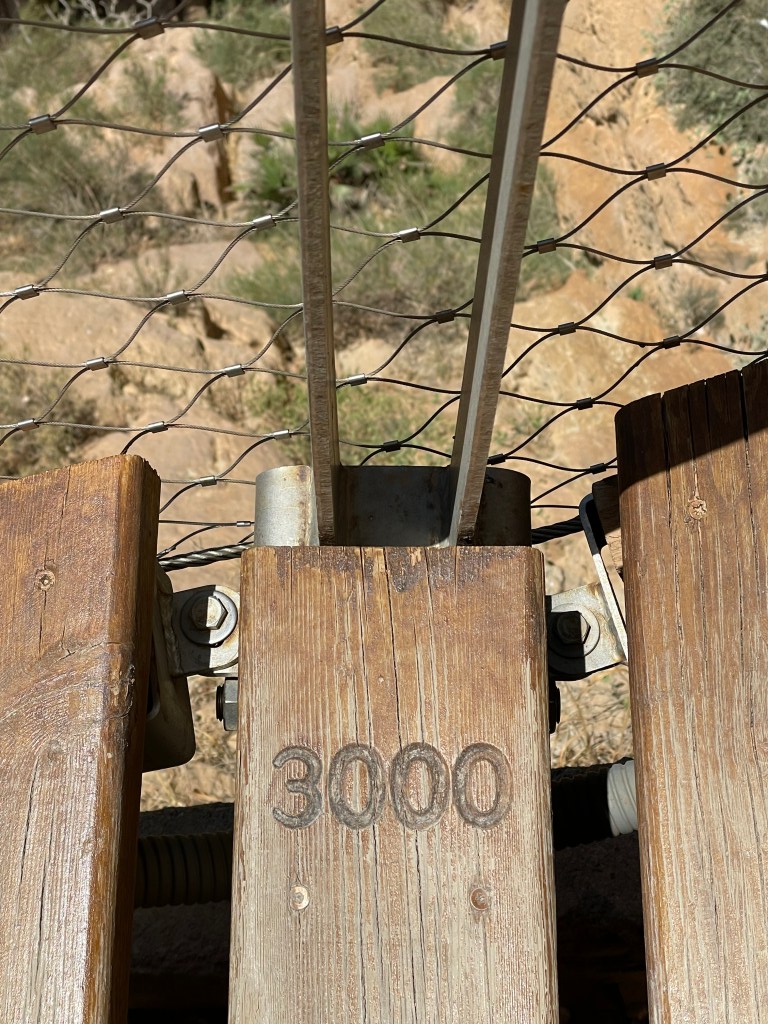
Wherever possible, Rosco walks close to the cliff. His pulse, he tells me, is at least 140 beats per minute. There’s a section where the rock overhangs the path, blocking all but the edge of the walkway. Rosco scrunches down and shuffles awkwardly under the rock, rather than walk to the edge where the head height is greater.

Sam tells us about the wildlife, including vultures, which we can see circling in the rising heat above us. “Great, Rosco mutters.
Midway along the walk, there’s a section where a huge vertical rock slab hangs off the edge of the mountain, tethered by four thin ropes of what I assume to be steal. “Loco! (crazy)” Rosco tells Sam, “it’s held there by string”. Rosco is right behind me as I stop to take a photo of the original, crumbling walkway underneath the vertical slab. Two seconds later I turn around, and he’s nowhere in sight. Rosco has skedaddled 100m away from the rock-held-up-by-string, breaking the land speed record in the process.
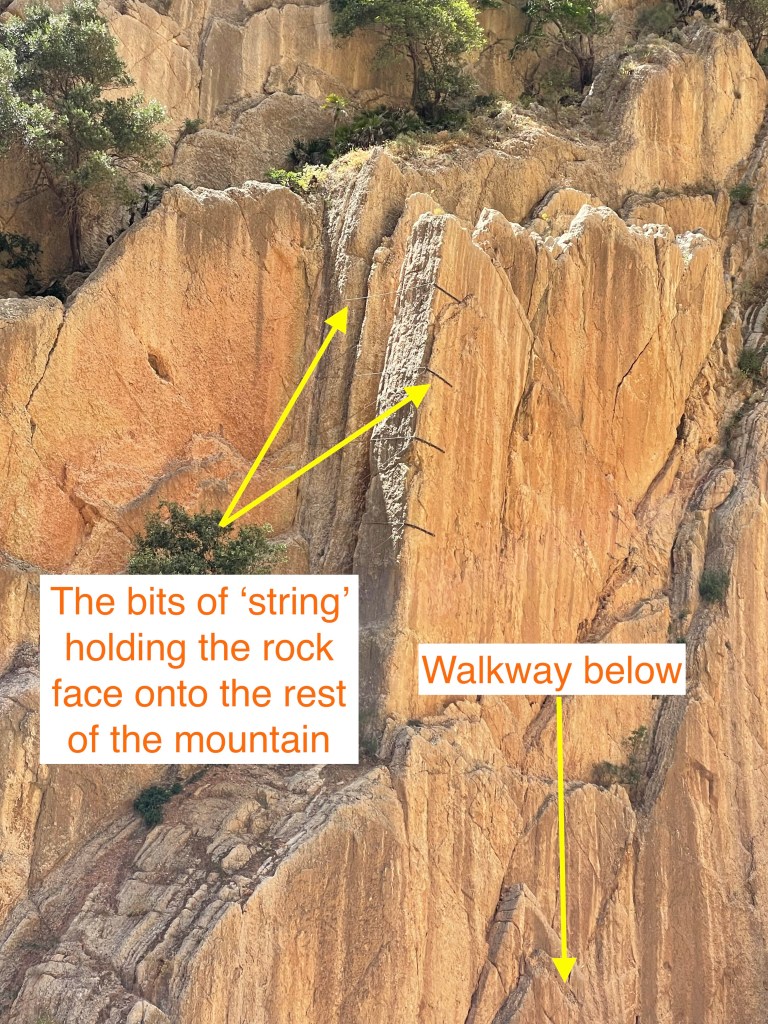
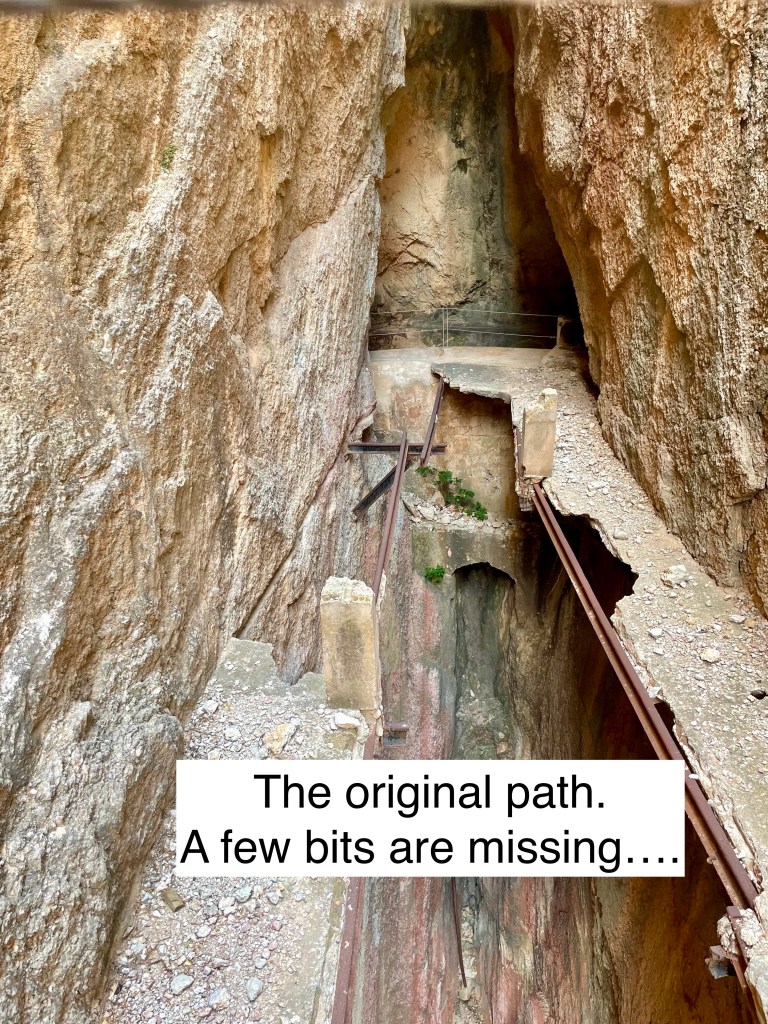
Many parts of the walkway are joined by what Sam described as ‘steps’, but in reality, they are more like ladders, and steep ones at that. Each tread is a narrow board, 4 or 5 inches wide and certainly not wide enough for your whole foot. The distance and height of each tread is irregular, so you’re never quite sure where to put your foot, or how far down you need to reach. Sometimes there’s a handrail, other times it’s tensioned wire.
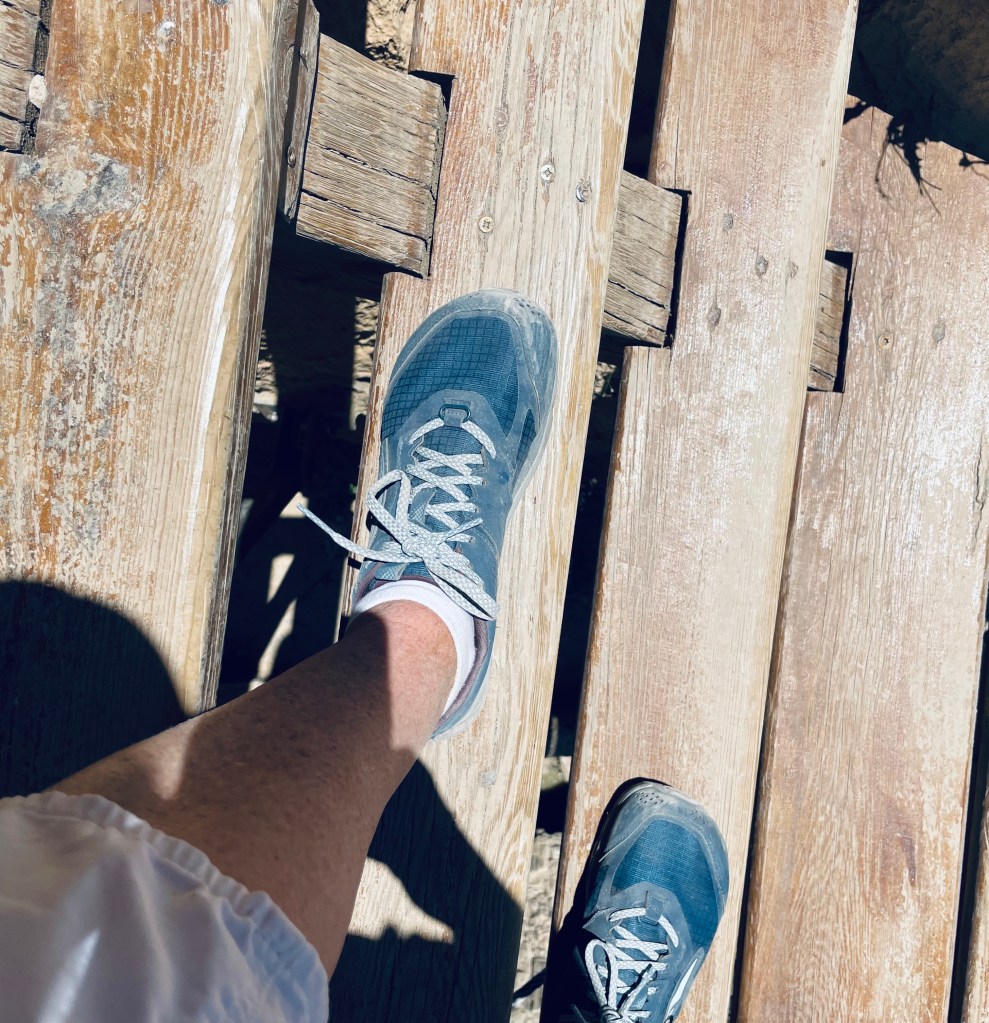
Towards the end of the trail, there’s a suspension bridge. It sways in the wind and bucks violently with the rhythm of each footstep. Rosco crosses the bridge in tiny, shuffling footsteps, clinging to the wire handrail, knuckles white, face ashen, sweat pouring off his body. After the bridge, there’s a series of steep, downward stairs ladders, the gaping space between each rung exposing the river far below. “That’s it Kacka. I’m done. I want to get off now.” Poor fella.
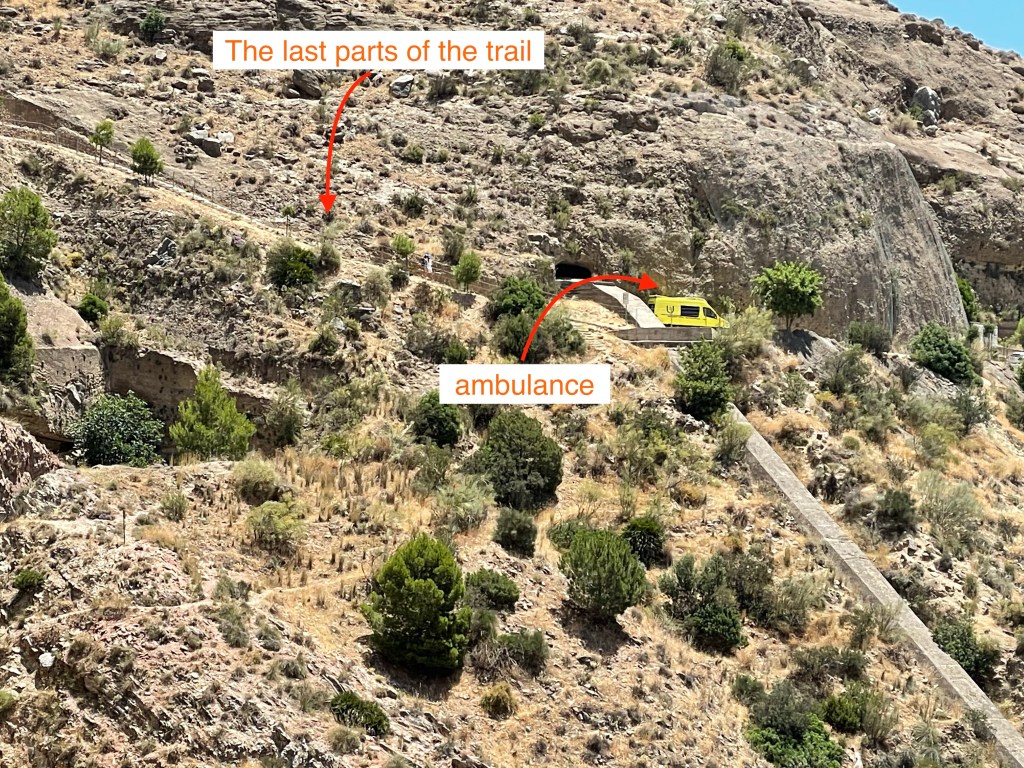
In the distance, we saw the ambulance near the finishing point. I’m not sure if that made him feel better or worse.
As it turns out, the ambulance is stationed there every day. It seems it is needed regularly for a range of reasons.
The Caminito Del Rey is 5km, although the elevated walkway section is only 3.5km. With a couple of water stops and chats, it took about three hours, end to end. The combination of the heat, dizzying heights and watching your footing on every step, made it quite mentally exhausting, more so if you suffer vertigo or fear of heights. Having said that, it’s not a hard walk. If you can put one foot in front of the other for 5km, you can definitely walk the Caminito Del Rey. It’s mostly flat, and mostly boardwalk with a couple of ‘ladders’ and a suspension bridge thrown in for fun. It’s also exhilarating. If you’re ever in the south of Spain, this hike is highly recommended. Tip: don’t do it in Summer and carry at least 2 litres of water with you.
Date: Friday 24 June 2022
Temperature: 28 degrees
Caminito Del Rey: 18€ each (group tour with guide, includes helmets)
Shuttle bus: 2.50€ each (mask required)
Train to El Chorro: 6.25€ each, one way (mask required)
Recovery drinks: 30€
Viva España
#CaminitoDelRey #Malaga #Spain #ILoveSpain #
 The Tepid Travellers
Another brilliant and hilarious blog. Rosco, save a couple of years and you seem to have suffered every emotion and facial expression that I did. Where did the expression that women are the weaker sex come from. Thank you Kari for a superb piece with great photos.
Looking forward to seeing you both soon. Rosco, we will put your seat away from the terrace balcony x
LikeLike
Xoxo. See you soon
LikeLike
Love this!!
LikeLike